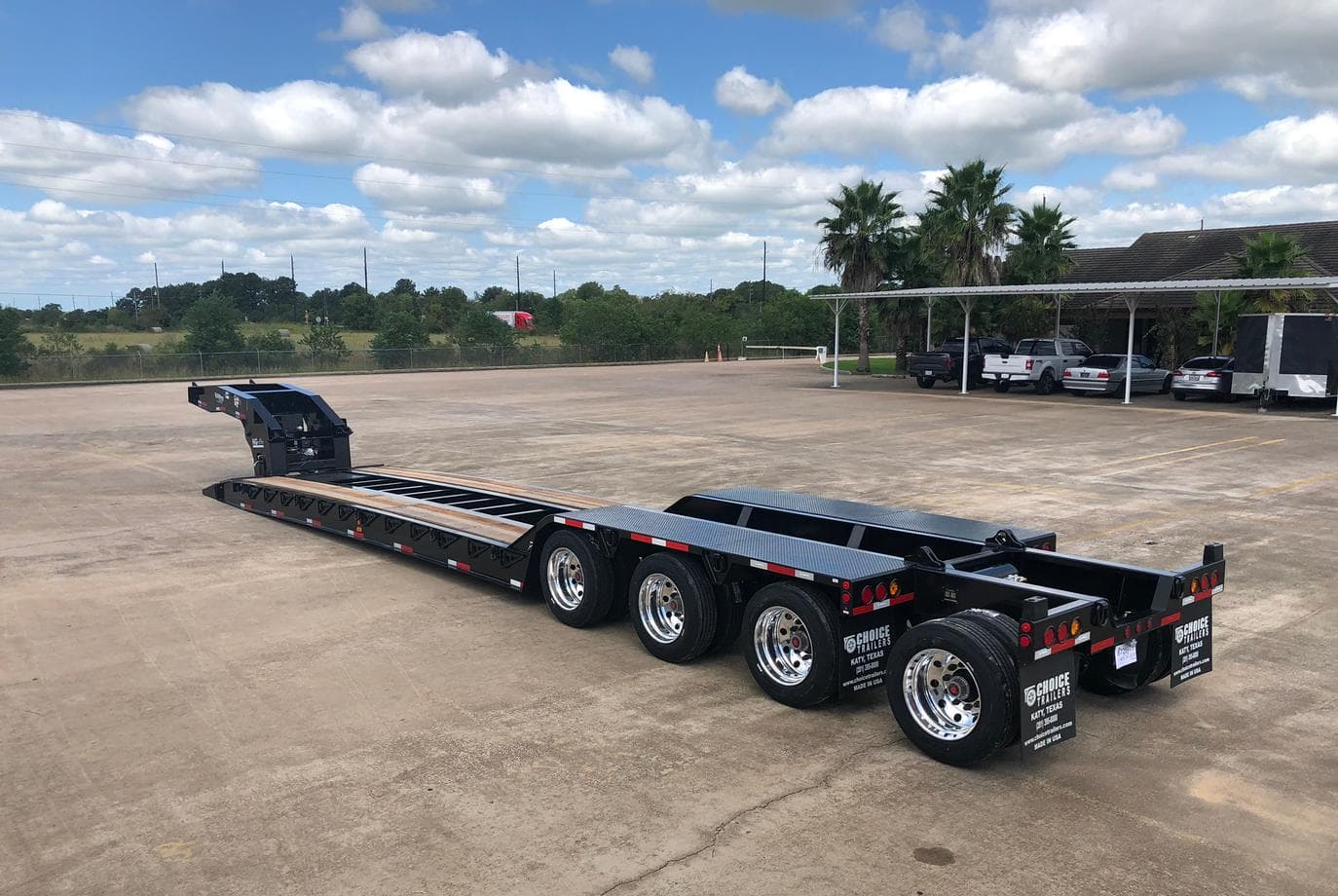

A step deck is a flatbed with the working deck dropped about a foot, and you buy the difference in legal load height. That is the whole trade. Everything else — width, securement, how you load it — is close enough to identical that it will not decide the purchase.
The comparisons you will find online quote round numbers: a flatbed is five feet off the ground, a step deck is three foot six, a step deck buys you twenty inches. Those figures disagree with each other because they are not measured off any particular trailer. Here are two that are, both standing on our yards.
Two real trailers, side by side
Flatbed — Manac 10248C000L (Salt Lake City) | Step deck — Dorsey DC53BTR-22.5 | |
|---|---|---|
Overall length | 48 feet | 53 feet |
Width | 102 inches (97 inches between side rails) | 8 feet 6 inches |
Deck height | approximately 59-1/2 inches at the front, 54 inches at the rear | upper deck 59 inches, lower deck 41 inches front, 42 center, 40.5 rear |
Usable low deck | none — one level | 38 feet, with a 10-foot upper deck over the tractor |
Legal cargo height under a 13-foot-6 ceiling | about 8 feet 6 inches to 9 feet | about 10 feet on the lower deck |
Published capacity | the listing publishes structure, not a rating | 80,000 lb GVWR standard beam package, 60,000 lb concentrated in a 10-foot span |
Deck material | aluminum inverted-T extrusions with four apitong or equivalent planks | 1-1/8 inch heavy-duty aluminum with two nailer boards |
Securement | extruded aluminum side rails, side boxes, rub rails | 24-inch stake pockets, 14 pairs of recessed chain ties, 12 Double L6 winches per side, double-L track both sides |
Rear loading | dock height at the rear, forklift or crane from side, rear or top | 60-inch beavertail at 15 degrees, two full-width self-cleaning spring-assist ramps, plus two 94-inch neck ramps |
Axles | fixed tandem, 122-inch spread | two 23,000 lb axles, air ride; the Salt Lake unit adds a rear axle slide |
Price on our yard | $47,900, 12 percent federal excise tax included | call for price |
The height math, done properly
Most states limit total vehicle height to 13 feet 6 inches, and some western states allow 14 feet. There is no single national number — it is set state by state, and your route decides it, so check the DOT for the states you run before you assume anything.
Work it against a 13-foot-6 ceiling, which is 162 inches:
- Off the rear of the Manac flatbed at 54 inches, you have 108 inches — 9 feet 0 inches of load.
- Off the front of the same deck at 59-1/2 inches, you have 102-1/2 inches — 8 feet 6-1/2 inches.
- Off the Dorsey's lower deck at 42 inches in the center, you have 120 inches — 10 feet 0 inches. At the rear, 40.5 inches, you have 121-1/2 inches.
So the step deck buys somewhere between twelve and eighteen inches of legal load height, and which number you get depends entirely on where you measure. Our flatbed deck is not flat front to rear. The Manac tapers from 59 and a half inches at the front to 54 at the rear, a five-and-a-half-inch drop across 48 feet, and that alone accounts for most of the disagreement between the round numbers you read elsewhere. Measure your own deck, at the point the load will actually sit, before you buy either trailer.
One more number the round figures hide: the first ten feet of a step deck sits at flatbed height. The Dorsey's upper deck is 59 inches, within half an inch of the Manac's front. A tall machine has to live on the lower 38 feet — the upper deck is for the freight that would have ridden on a flatbed anyway.
What you actually give up
A step deck is not a strictly better flatbed. Four things move the other way.
Deck length is split. Fifty-three feet on paper, 38 of it usable at low height. A long load that will not tolerate a step has to ride the flatbed.
Dock work is harder. A flatbed's deck is close to trailer-dock height along its whole length. A step deck's low deck is not, and its rear is a beavertail, so backing to a dock and running a forklift straight on is a flatbed job.
More trailer, more tare. Ramps, a beavertail, a stepped frame and a slide all weigh something, and every pound of them comes out of payload.
More money. The Manac is listed at $47,900 with the federal excise tax included. The step decks are call-for-price, and a step deck of the same class will not come in under a comparable flatbed.
The rule
- Your tallest regular load clears about 8 feet 6 inches on a flat deck. Buy the flatbed. It is cheaper, simpler, docks better and gives you a full 48 feet on one level.
- Your loads land between about 8 feet 6 inches and 10 feet 2 inches. Buy the step deck. That range is exactly the band where a flatbed needs a permit and a step deck does not.
- Your loads top about 10 feet 2 inches regularly. Neither one. That is lowboy or RGN territory, where a recessed well buys the height back — start with our lowboy vs. step deck spec guide, which has the deck heights, capacities and permit thresholds in one table.
- You are hauling material rather than machines. Different question entirely — that is dump equipment, not an open deck.
Step deck, drop deck and single drop are three names for the same trailer, so do not read a spec sheet as offering something different because it uses a different word. A double drop is a different trailer, with a well between the two decks.
"Friendly and helpful staff, Wesley didn’t give up till he found the trailer we were satisfied with, even helped us sell our used trailer"
— Timothy S., Western Truck & Trailer customer (Google review, Belgrade, MT)
Buying either one from Western
Western has sold commercial trailers since 1983 out of four yards: Salt Lake City, North Las Vegas, Belgrade, and Atlanta, Texas. Both categories are shallow by design — a couple of decks at a time — so most buyers spec a build rather than pick one off the row. In-stock units ship in days; a factory order runs 8 to 16 weeks, which means a deck you want for spring gets ordered in winter. Financing is $0 down for qualified buyers, terms to six years, seasonal skip payments and a 60 to 90 day deferred first payment. Parts and service run out of Salt Lake City and North Las Vegas; Belgrade and Atlanta are sales yards. Delivery is nationwide.
See what is on the ground: flatbed and step deck trailers in stock. Or call (888) 615-1388 with the machine, its height and operating weight, and the states you run, and we will tell you which deck keeps you legal.
Frequently asked questions
A flatbed has one deck at a single level. A step deck has two: a short upper deck over the tractor and a longer main deck dropped about a foot lower behind it. The lower deck is the entire point — it buys legal load height. On the two trailers on our yard the flatbed deck runs 54 to 59-1/2 inches and the step deck's lower deck runs 40.5 to 42 inches.
Roughly twelve to eighteen inches more than a flatbed, depending where on the flatbed deck you measure — flatbed decks taper front to rear. Against a 13-foot-6 ceiling that works out to about 8 feet 6 inches to 9 feet of load on a flatbed, and about 10 feet on a step deck's lower deck. Height limits are set by the states, not nationally, and some western states allow 14 feet, so check your route.
Yes. Step deck, drop deck and single drop all describe the same two-level trailer, and dealer and marketplace listings use all three. A double drop is a different trailer — it adds a well between the upper deck and the rear axles for taller loads still.
Work from your tallest regular load, not your average one. Under about 8 feet 6 inches on a flat deck, a flatbed is cheaper, simpler and docks better. Between about 8 feet 6 inches and 10 feet 2 inches, the step deck keeps you legal where a flatbed needs a permit. Above that you want a lowboy. Call the branch with the machine height and the states you run and we will spec it against the load.