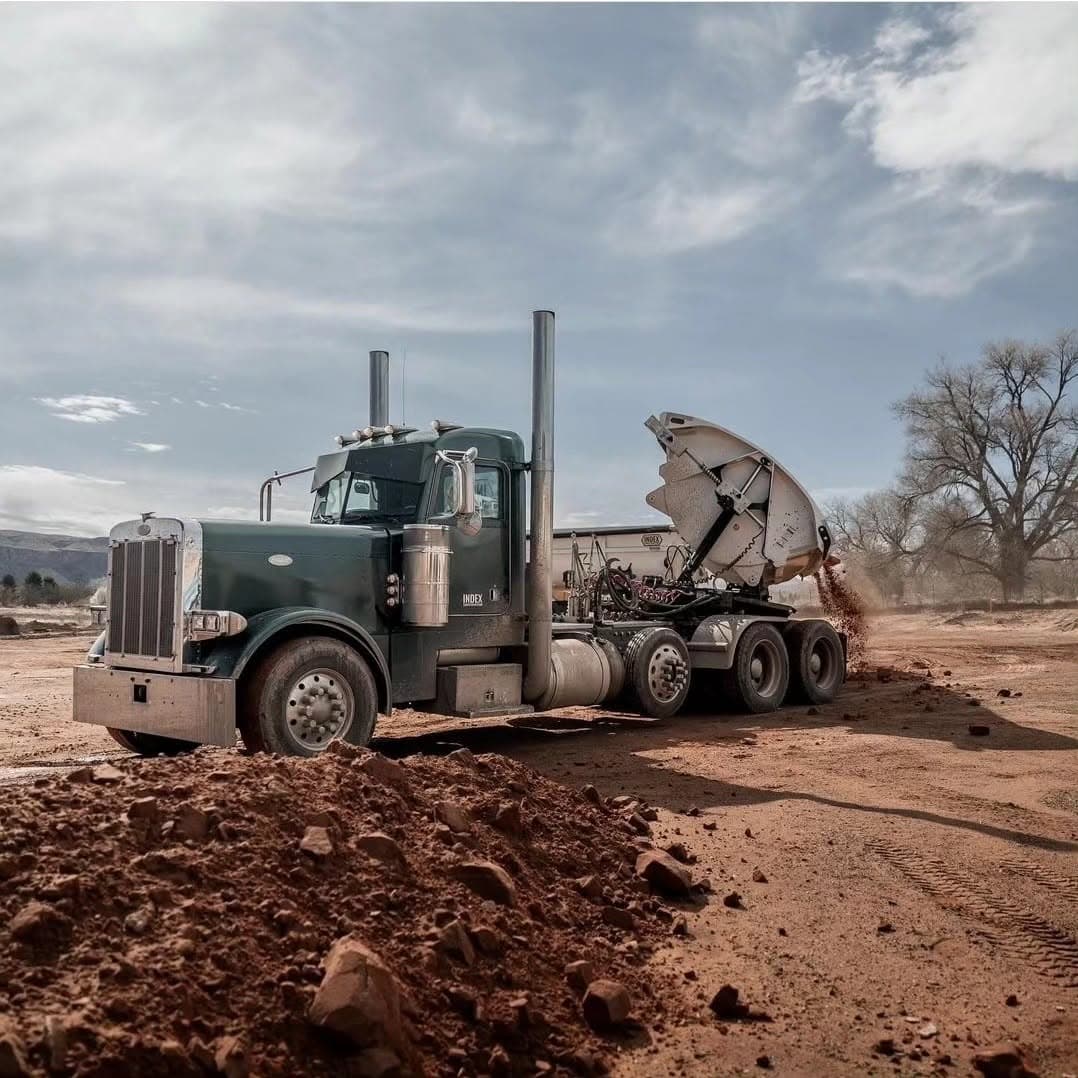

The short answer, from trailers standing on our yards right now: a single belly dump runs about 20 to 23 cubic yards. A side dump runs about 23 to 27 cubic yards struck, or 30 to 36 heaped. End dumps are the widest spread of the three — a short elliptical is under 30 cubic yards and a frameless high cube is nearly a hundred.
The longer answer is the one you actually need, because cubic yards is only half the question. A full tub and a legal load are two different numbers, and on anything heavier than mulch the axles run out first. Here are the real capacities, then the arithmetic that decides which number you get.
What Western's own trailers hold
Trailer | Type | Published capacity | Length | Price |
|---|---|---|---|---|
CPS 4B240A200 | Belly dump | 20 cu yd, single hopper — 23 to the top of the bangboards | 40'-0" | Call for price |
Ranco LW21-37-2 | Belly dump | 21 cu yd | 37' | $72,900 |
Ranco "10 Axle Setup" — LW21-40-3 lead plus 14-24-4P pup | Belly dump pair | 21 cu yd + 14 cu yd | 40' + 24' | $164,900 for the pair |
Ranco ED26-34 | End dump | not published — 45" tub height | 34' | $67,900 |
Ranco ED32-34 | End dump | not published — 54" tub height | 34' | $67,900 |
SmithCo SX3-42-34 | Side dump | 22.8 cu yd water level / 30.3 heaped | 42' frame, 34' tub | $87,900 |
SmithCo SX5-49-38 | Side dump | 25.5 / 33.8 | 49' frame, 38' tub | $127,900 |
SmithCo SX6-53-40 | Side dump | 26.8 / 35.6 | 53' frame, 40' tub | $142,900 |
Prices include the 12 percent federal excise tax. Stock turns — check the listing before you budget.
One row needs reading carefully. Our "10 Axle Setup" listing is not one trailer: it publishes two spec blocks joined by the line "This listing also includes:" — an LW21-40-3 lead at 21 cubic yards on 40 feet, and a 14-24-4P pup at 14 cubic yards on 24 feet. The $164,900 buys the pair, which is why it sits so far above the single LW21-37-2 at the same 21 cubic yards.
Two things stand out in that table. Side dumps carry more than belly dumps of the same length, because a side dump is a tub and a belly dump is a hopper with gates through the floor. And the whole SmithCo range, three axles to six, moves only four cubic yards. Capacity is not what you are buying when you go up the model line.
Water level, heaped, and "to the bangboards"
Three different numbers get published as "capacity", and quoting a job on the wrong one is how a load ends up short.
Water level is what fits struck flat. Heaped is what fits mounded. To the bangboards is a third number again — the volume you get once the wooden or aluminium boards on top of the hopper are in play, which is where the CPS trailer's 20 cubic yards becomes 23.
Which one applies depends on your material. Dry aggregate and road base mound; wet sand and spoil slump flat and heaped is fiction. Ranco publishes both numbers on its Super 12 elliptical end dump — 28 yards, 31 at the bangboards — for exactly this reason, and SmithCo publishes water level and heaped on every side dump. If a spec sheet gives you one number and does not say which, ask.
Yards is the wrong question. Tons is the question.
Load King publishes the two numbers together on its LK-2060-40-2 bottom dump, and it is the most useful pair of numbers in this whole business: a 20 cubic yard struck capacity, an estimated trailer weight of 13,780 pounds, and — in its own words — "a rated net payload of 60,000 lbs, or 30 tons."
Load King rates that same trailer at 60,000 pounds of payload, or 30 tons. Twenty cubic yards against 30 tons is 3,000 pounds per cubic yard — a ton and a half — which is the manufacturer's own working assumption for what goes into a bottom dump.
Now put a truck under it. Federal law caps you at 80,000 pounds gross on the Interstate without a permit. Subtract the trailer's published 13,780 pounds, subtract your tractor, and what is left is your legal payload — comfortably under that 60,000-pound structural rating for any real tractor. Fill 20 cubic yards with material at a ton and a half a yard and you are at 30 tons of product before anyone weighs the truck.
That is the whole thing. You fill either the tub or the axles, whichever comes first, and with aggregate it is always the axles. Which is why the honest answer to "how many tons can a belly dump hold" is not a number off the tub. It is whatever the axles under it are allowed to carry in the state you are running.
What more axles actually buy
This is why the dump lines climb in axle count rather than in tub size.
- Standard rig, federal cap: 80,000 pounds gross, no permit. This is the baseline everything else is measured against.
- Extended-weight states: SmithCo says its five-axle SX5 "works well in most states that have a cap gross weight allowed of up to 108,500 lbs." The extra liftable, steerable axle behind the landing legs is there to spread the load, not to hold more dirt.
- The top of the single-trailer range: SmithCo's six-axle SX6 "allows operators with a standard CDL to haul up to 37.4 tons in a single trailer… without exceeding 129,000 GVW rating with the right truck configuration."
- A belly dump train: Ranco's Extra Capacity Pup pairs a 40-foot three-axle LW21-40-3 lead with a 24-foot four-axle 14-24-4P pup — 81 feet overall, 38 cubic yards with side boards, 129,000 pounds gross. Two tubs, seven trailer axles. Operators call a matched pair a belly dump train, and that is exactly what our "10 Axle Setup" listing publishes: an LW21-40-3 tri-axle lead plus a 14-24-4P quad pup, seven trailer axles between them.
Read that list in one go and the pattern is obvious: from a standard rig to a train, tub volume roughly doubles while gross weight goes from 80,000 to 129,000 pounds. You are buying axles.
Read the build sheet, not the model number
On Ranco's belly dump line the number after the letters is the capacity in cubic yards, and Ranco publishes it: the LW21-40-3 is 21 yards on a 40-foot frame, the LW21-42-3 is 21 yards on 42 feet, the 14-24-4P pup is 14 yards on 24 feet. Our own LW21-37-2 listing says "21 CU.YD." in the specs.
The end dumps do not work that way. Ranco publishes no cubic-yard figure on those two listings, so do not read the model number as a capacity. What the ED26-34 and ED32-34 listings do publish is more useful anyway: both are 34 feet long, and the difference between them is a 45-inch tub wall against a 54-inch one. Nine inches of wall across a 34-foot tub is a lot of material. If you are quoting a job on volume, get the figure off the build sheet for the exact unit — not off the model name, and not off a competitor's blog.
Buying or renting one from Western
Fourteen side dumps, eight belly dumps and three end dumps were on the ground across our four yards when this was written, from Ranco, SmithCo, CPS and Manac. In-stock units ship in days; a factory build runs 8 to 16 weeks. Financing is $0 down for qualified buyers, terms to six years, seasonal skip payments and a 60 to 90 day deferred first payment.
See what is on the yard: belly dump trailers on the yard, end dump trailers in stock, or side dump trailers. Call (888) 615-1388 with the material, the tonnage you need per trip and the states you run, and we will spec the axle count against the load instead of the brochure.
Frequently asked questions
A single belly dump holds about 20 to 23 cubic yards. The CPS 4B240A200 on our yard publishes 20 cubic yards in a single hopper and 23 to the top of the bangboards on a 40-foot frame; Ranco's LW21 trailers publish 21 cubic yards at 37, 40 and 42 feet. A matched pair — a belly dump train — is a different figure: Ranco pairs a 40-foot three-axle lead with a 24-foot four-axle pup for 38 cubic yards with side boards.
Whatever the axles under it are legally allowed to carry, which is almost always less than the tub will physically hold. Load King rates a 20-cubic-yard bottom dump at 60,000 pounds, or 30 tons, on a trailer that weighs 13,780 pounds empty — but federal law caps you at 80,000 pounds gross on the Interstate without a permit, and your tractor comes out of that too. Extended-weight states and more axles change the answer: SmithCo publishes up to 108,500 pounds gross for its five-axle trailer and up to 37.4 tons in a single six-axle trailer at a 129,000 GVW rating.
Between about 23 and 27 cubic yards struck, and 30 to 36 heaped, across the SmithCo range we stock. A 34-foot tub publishes 22.8 water level and 30.3 heaped; a 40-foot tub publishes 26.8 and 35.6. Which number applies depends on whether your material mounds.
More volume for the same trailer length, because a side dump is a single open tub and a belly dump is a hopper with gates through the floor. A 38-foot side dump tub publishes 25.5 cubic yards water level against 21 for a 40-foot belly dump. Legal payload, though, is set by axles and weight law, not by which tub is bigger.
Water level, sometimes called struck, is the load levelled flat with the top of the tub. Heaped is the load mounded above it. Bangboard capacity is the volume you get with the boards on top of a belly dump hopper in play. The same trailer can honestly be advertised with all three numbers, which is why the one to quote a job on is the one on that unit's own build sheet.
Sometimes. On Ranco's belly dump line it does — an LW21 is 21 cubic yards, a 14-24-4P is 14 — and Ranco publishes those figures. On its end dump line it does not; those listings publish overall length and tub height instead. On SmithCo side dumps the first number is the axle count, not a capacity. Read the build sheet.